Should You Cycle Your Supplements? What to Take Daily, Test, or Trial

Written By
Healthvizor
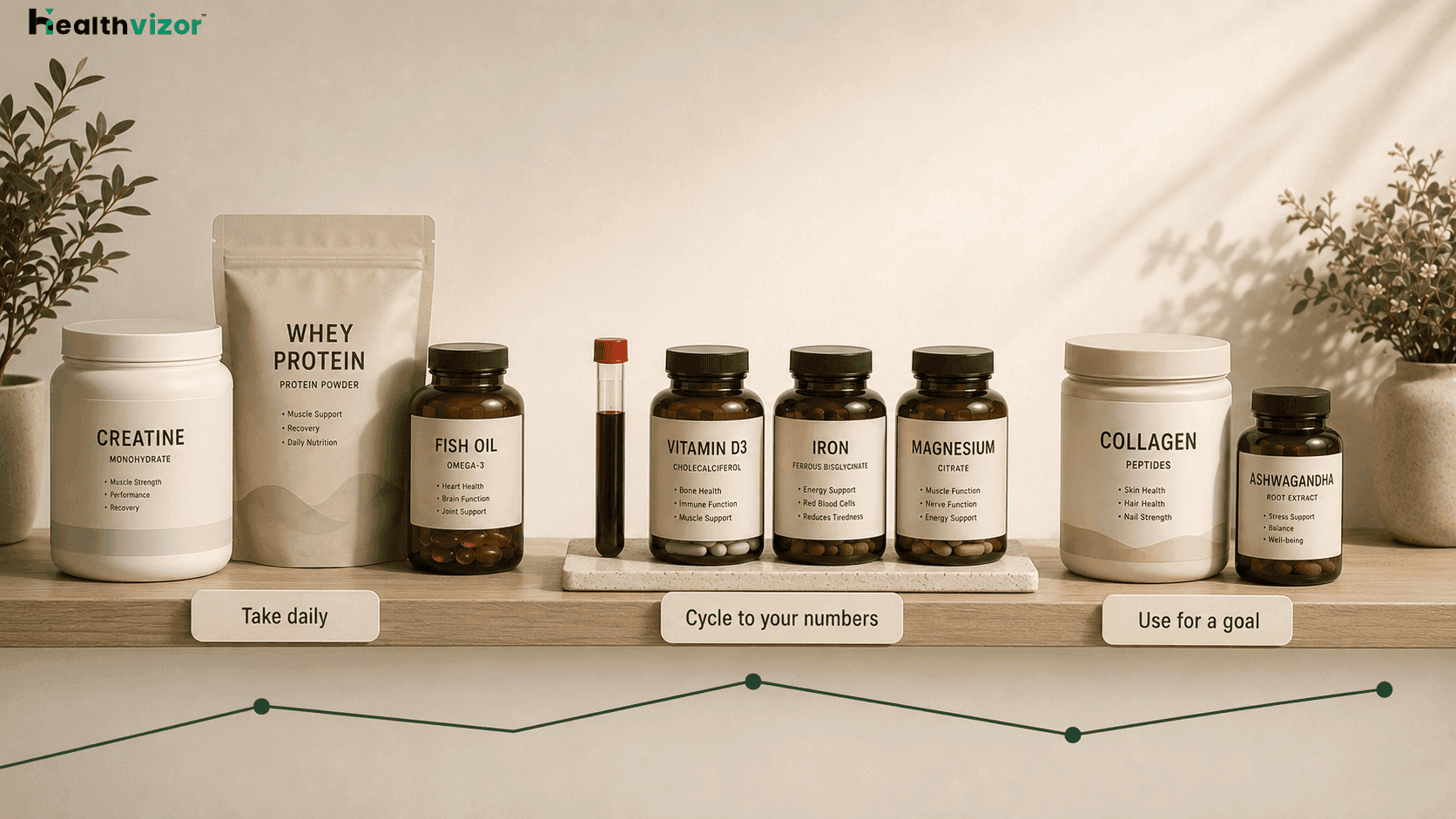
Supplement brands tell you what to start. Influencers tell you how much to take. Almost nobody tells you when to reassess, or stop.
That is how a vitamin D correction becomes a permanent high-dose habit, how a person with fatigue starts iron without ever checking their ferritin, and how a five-product stack quietly becomes twelve.
So should you cycle your supplements? Sometimes, but not because your body needs a vague "reset." The honest answer depends on what you are taking and why. Some supplements you take every day and never cycle. Some you adjust against your blood numbers. And some you use for a specific goal, then stop. This piece sorts the common ones into those three groups.
There is a deeper principle underneath all of it, and it is the one Healthvizor is built on: normal and optimal are not the same thing. A lab reference range tells you where you sit against a general population. It does not tell you whether your number is where it should be for your age, training and goals. Cycling is not a calendar habit. It is a response to your own numbers. That is the whole idea behind Healthvizor: understand your health, prioritize what matters, and know what to do next.
Three questions that replace every cycling rule
Before you start or continue anything, ask:

• Does your body store it? Fat-soluble vitamins and some minerals build up. Most water-soluble vitamins do not.
• Can you build tolerance to it? A few compounds adapt. Most nutrients do not.
• Did you start it for a measurable reason? A deficiency, a symptom, or a performance goal. If you cannot name one, that is your answer.
Take daily: do not cycle these
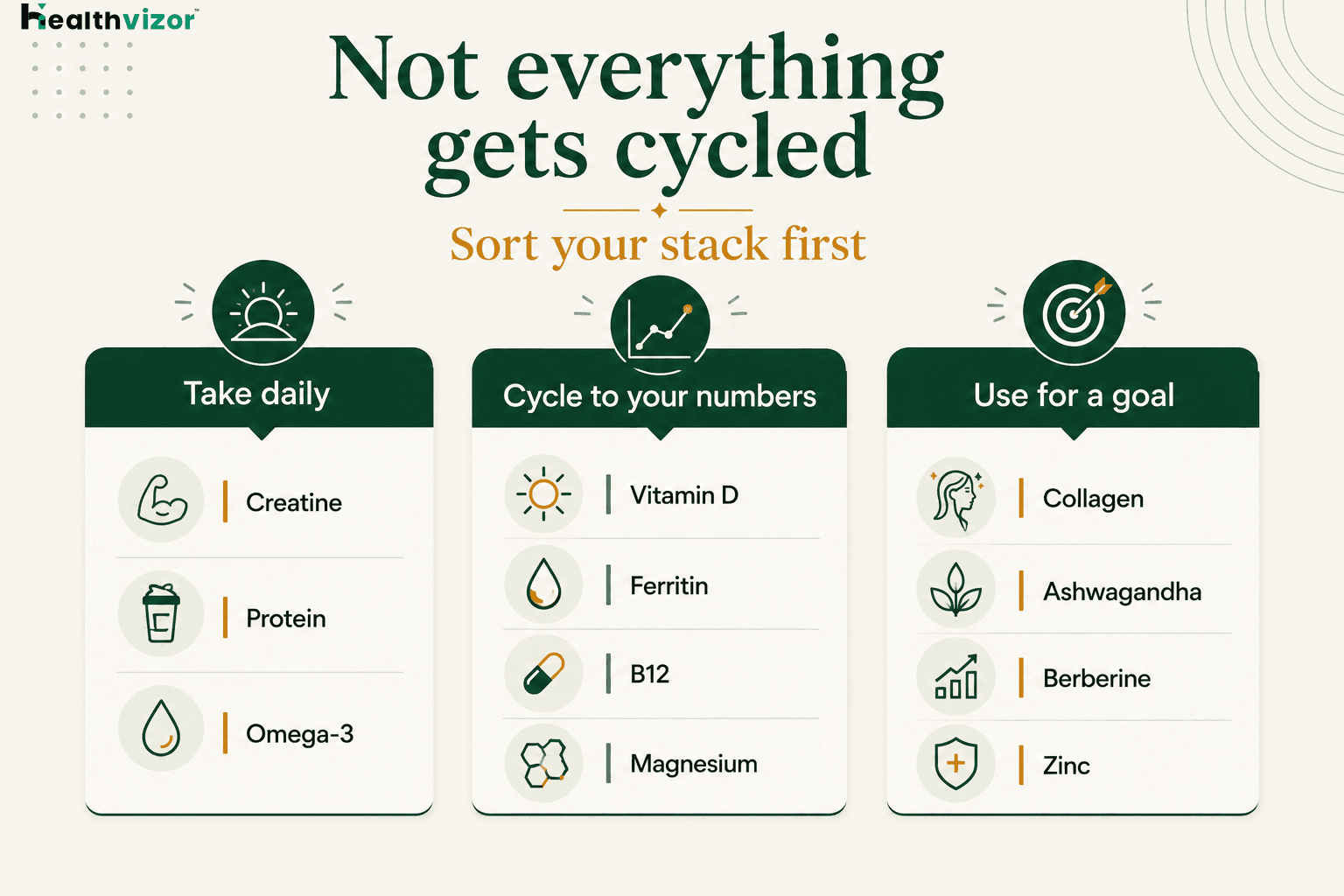
These earn a permanent place. Cycling them off just interrupts the benefit. The lever here is dose, not on and off.
Creatine monohydrate
Why it is a daily keeper
Strength, power, faster recovery; cognitive support if your baseline is low, as in vegetarians and older adults.
Typical dose
3–5 g/day
Cycle?
No. Muscle stores stay saturated and never fall below baseline when you stop. [1]
Protein / whey
Why it is a daily keeper
The raw material for muscle, recovery and healthy aging.
Typical dose
Aim near 1.6 g/kg/day total, up to about 2.2 if training hard; powder just fills the gap.
Cycle?
No.
Omega-3 (EPA/DHA)
Why it is a daily keeper
Recovery, triglycerides, heart and brain.
Typical dose
1–2 g EPA+DHA per day for general health, 2–4 g for athletes; choose EPA-dominant, and read the label for actual EPA+DHA, not the "fish oil" number on the front.
Cycle?
No. Dose to your omega-3 index, aim above 8%. [3] not the calendar
Cycle to your biomarkers, not the calendar
This is the "yes, cycle, but to a number" group. You do not run these on a schedule. You bring the marker into its optimal range, then hold and retest. These are the numbers most worth knowing.
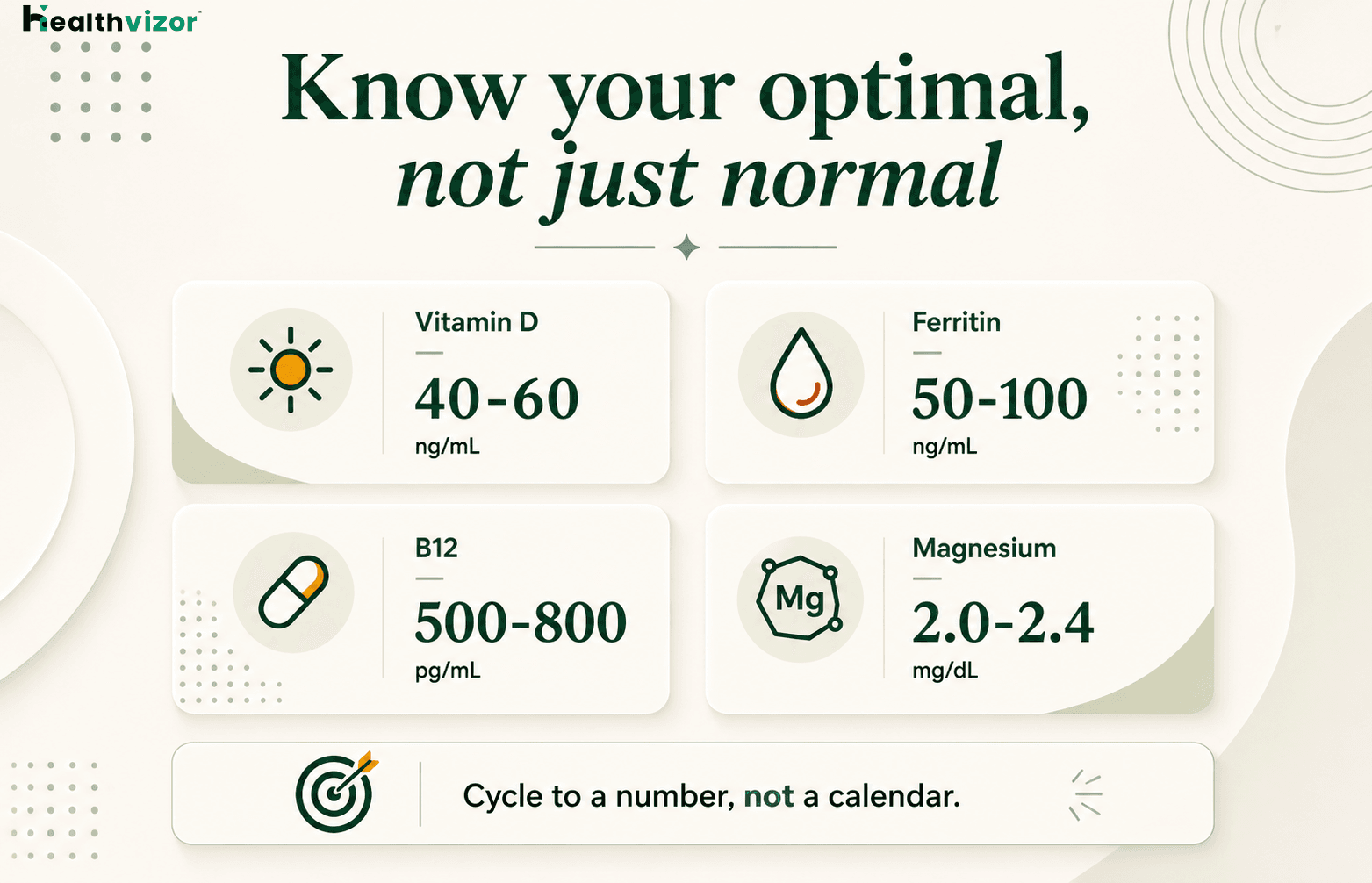
Vitamin D
Healthvizor optimal
40–60 ng/mL
How to get there
1,000–2,000 IU/day to maintain; correct a low over a defined window under guidance, then hold. [4]
Retest
3 months, then every 6 months
Ferritin (Iron)
Healthvizor optimal
50–100 ng/mL
How to get there
Food first; add iron only if you are low. Many menstruating women sit below this and have to actively defend it, so test before you dose. [5]
Retest
3 months
Vitamin B12
Healthvizor optimal
500–800 pg/mL, with homocysteine under 9
How to get there
Correct if low, then recheck homocysteine.
Retest
3 months
Magnesium
Healthvizor optimal
Serum 2.0–2.4 mg/dL, the high end of the lab range of about 1.8–2.6
How to get there
A well-absorbed form (glycinate, citrate or malate, or a multi-form blend), around 300 mg/day of elemental magnesium for sleep, recovery and performance; the supplemental upper limit is 350 mg/day. [6]
Retest
3 months, then every 6 months
Use for a goal, then reassess
These earn a place only for a specific job, and come off when the job is done.
Collagen
Best used for
A tendon, joint or skin goal.
Typical dose
15 g with about 50 mg of vitamin C, roughly an hour before loading exercise.
The cycling move
Time-boxed trial, then stop. It is not a complete protein or a whey substitute. [7]
Ashwagandha (KSM-66)
Best used for
A trial for stress or sleep.
Typical dose
300–600 mg/day of standardized extract.
The cycling move
6–12 week trial; keep it only if it clearly helps. It can affect the thyroid and has rare but real liver injury, including reported cases in India, so avoid it with liver or thyroid disease. [8]
Berberine
Best used for
Metabolic support.
Typical dose
Discuss the dose with a clinician.
The cycling move
Treat it like a medicine, not a wellness powder. It has real glucose-lowering effects and drug interactions.
Zinc
Best used for
Short bouts, such as immune support.
Typical dose
Short courses at sensible doses.
The cycling move
Short-term only. Long-term high doses drain copper. [9]
How often should you retest?
You do not need monthly bloodwork. These markers move over weeks to months, not days. A simple rule:
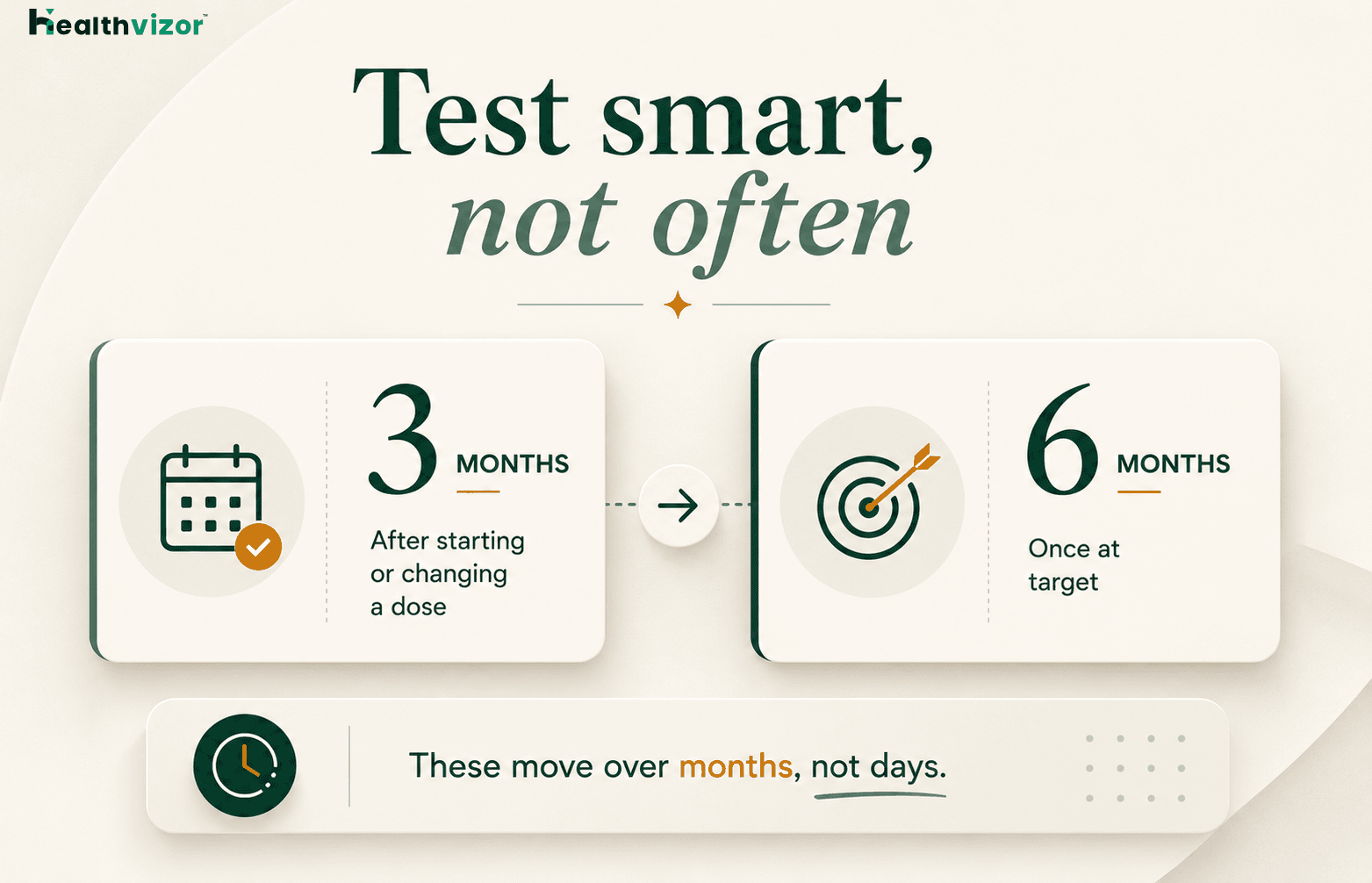
• Retest about 3 months after you start a supplement or change a dose. That is long enough for vitamin D, ferritin, B12 and the omega-3 index to actually move.
• Once you are at your target, retest every 6 months to make sure you are holding.
That cadence catches drift early without overtesting.
The bottom line
The goal is not the biggest stack. It is the smallest, most targeted plan that moves your numbers in the right direction and keeps them there.
Healthvizor helps you feel healthier today so you can live healthier for longer. We interpret your biomarkers across nutrient status, metabolism, inflammation, thyroid, hormones, cardiovascular health, strength and recovery, then show you where you sit against optimal ranges, what to prioritize, and what to do next.
Frequently Asked Questions
Not necessarily. Supplement strategies vary by type. Dietary staples (like protein or creatine) are often taken continuously for baseline support, whereas cycling is typically reserved for botanicals or nutrients that accumulate in body tissues.
Instead of taking fixed doses indefinitely, biomarker-guided supplementation involves testing levels (such as vitamin D, iron, or B12) to see where you stand. Intake can then be tailored or paused under medical guidance to stay within targeted health ranges.
Nutrient markers generally move over weeks or months. A common practice is rechecking levels about 3 months after changing a regimen to monitor progress, followed by periodic checks every 6 to 12 months to ensure balance.
Targeted ingredients like ashwagandha or single high-dose minerals (like zinc) are often taken for short, defined periods. This approach allows individuals to evaluate effectiveness while avoiding potential tolerance build-up or nutrient imbalances.
1. Standard reference ranges: Broad statistical averages used by clinical labs to identify disease states or severe deficiencies.
2. Target optimal ranges: Narrower ranges referenced in preventive wellness literature aimed at supporting day-to-day vitality and long-term performance.